
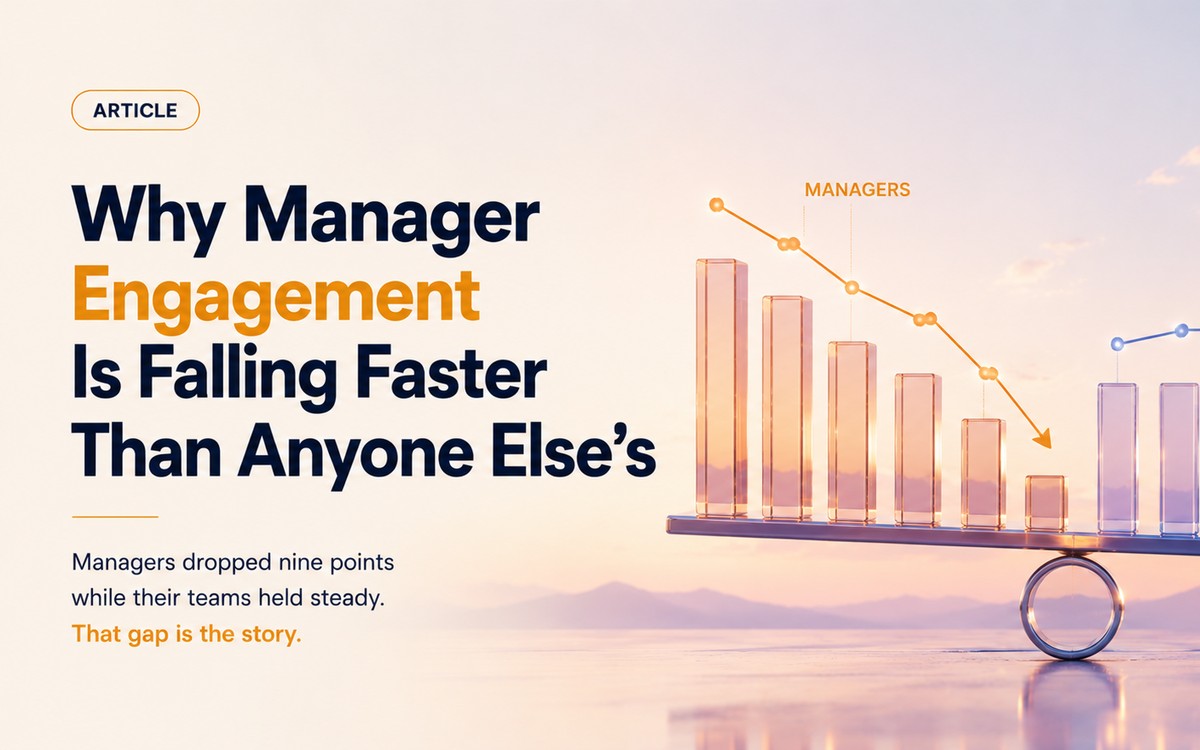
Gallup's State of the Global Workplace 2026 found manager engagement fell nine points since 2022, from 31% to 22%, while engagement among the people they lead moved only one point. Spans of control widened and the management layer thinned over the same period. Here is why that pattern points at conditions rather than character, read through Ability, Character and Environment.
Manager engagement is falling faster than anyone else's because the manager's job changed and the support around it did not. Gallup's State of the Global Workplace 2026 found that global manager engagement dropped nine points between 2022 and 2025, from 31% to 22%, while engagement among the people they lead fell only one point, from 20% to 19%. The gap that used to exist between managers and their teams, the small premium that came with the role, has almost closed. Gallup is direct about what this means for the global picture: lower engagement among managers accounts for most of the recent downturn in employee engagement worldwide.
That is a specific finding, and it deserves a specific response. What it is getting instead, in most organisations I talk to, is another round of resilience training.
Because the role absorbed a decade of structural change in about three years, and the numbers show where it landed. Gallup's 2026 report puts global engagement at 20% in 2025, its lowest level since 2020, and estimates the cost to the world economy at around $10 trillion in lost productivity, or 9% of GDP. Inside that total, the manager line is the one that moves. Manager engagement went 31%, 30%, 27%, 22% across 2022 to 2025. The steepest single year was the last one, a five-point fall from 27% to 22%.
Individual contributor engagement over the same window went 20%, 18%, 18%, 19%. It dipped and partially recovered. The manager line did not. Whatever is happening, it is happening to a role, not to a workforce.
The span widened and the layer thinned. Gallup's span-of-control study, published in January 2026, found the average manager went from 10.9 direct reports in 2024 to 12.1 in 2025, and that the average has climbed nearly 50% since 2013. Gallup is careful about that average, and so should we be: the median manager still leads five to six people, and about two thirds oversee fewer than ten. A minority of very large teams is pulling the mean upward. But the direction is not in dispute, and Gallup's own analysis found manager engagement declines as spans of control grow.
At the same time, the layer itself is being reduced. Gartner predicted in October 2024 that through 2026, 20% of organisations would use AI to flatten their structure, eliminating more than half of current middle management positions. That is a forecast rather than a measurement, and it should be read as one. The measured side is thinner and comes from private data: Live Data Technologies, reported by the Wall Street Journal, found manager headcount at US public companies fell 6.1% between May 2022 and May 2025.
Honesty about that evidence matters. A serious counterargument runs alongside it, and it is a good one. Analysts including Mizuho's Dan Dolev have argued that much of this cutting traces to a post-pandemic hiring correction rather than to AI, and research from Oxford Economics and the NBER has found similar patterns in firms that publicly attributed layoffs to AI. Some of what gets described as a structural revolution is a company unwinding a hiring spree with a more fashionable explanation attached. You do not need the AI story to be true for the manager's experience to be real. Either way, more people report to them, fewer peers stand beside them, and the translation work has multiplied.
That translation work is the part that rarely appears on an org chart. Managers convert strategy into priorities, change into habits, and uncertainty into something a team can act on tomorrow morning. When you widen the span and thin the layer, you have not removed that work. You have concentrated it.
Because it treats an environmental signal as a personal deficit, and the two need different responses.
Here is the logic. If managers and their teams were both disengaging at similar rates, you would be looking at a broad cultural or economic story. That is not what the data shows. One band fell nine points while the band directly below it moved one. The people in that band did not collectively lose their motivation in the same three years. Their conditions changed, in a way that is documented: more reports each, fewer peers, more change to translate, less room to absorb it.
Offering that group a resilience workshop is not wrong exactly. It is misdirected. It asks the person to build more capacity to withstand conditions that nobody has agreed to change. If the conditions are the driver, the honest version of that intervention is: we are going to keep the pressure where it is, and we would like you to get better at carrying it. Most managers can hear that subtext perfectly well, which is part of why the training lands badly.
This is the distinction that adaptability measurement is built to make. AQ assesses a person's Ability to adapt and the Environment they are adapting in as separate things, precisely because the same exhaustion can come from two opposite places. Someone can be depleting from the inside while working somewhere supportive. Someone else can have real capacity that their conditions never let them use. Those two people look similar in a wellbeing survey and need almost opposite interventions. Without separating capacity from conditions, organisations default to the intervention that is cheaper and less politically costly, which is nearly always the one aimed at the individual.
AQ, or Adaptability Quotient, is a measure of how a person adapts, made up of three components: Ability, Character and Environment. Read the manager story through each and the response gets more precise.
Ability covers the adaptive skills a person can develop, including how they unlearn what used to work. This is the genuinely individual part of the manager squeeze, and it is real. The job many managers were trained for, coordinating work and reporting upward, is being automated at exactly the point where the human part of it, judgement and translation and holding a team together through ambiguity, is becoming the whole job. That is an unlearning problem before it is a skills problem. You cannot bolt new capability onto a definition of the role that no longer applies.
Character covers the stable traits that shape how someone meets change, including grit, resilience, motivation style, mindset and hope. Hope is the one that matters most here and the one most often dismissed as soft. Hope in this context is not optimism about the future. It is a person's sense that there is a route from here to somewhere better and that they have some agency on it. Strip out the layer above and the layer below, tell a manager the structure is flattening, and you have not just increased their workload. You have made the route harder to see. Engagement is a reasonable thing to lose when the path disappears.
Environment covers the conditions surrounding the person, including work stress, team support and company support. On the evidence, this is where the manager story sits. It is also the component leaders actually control. You cannot instruct someone to have more grit. You can change a span of control, restore a peer group, cut the number of simultaneous changes a team is asked to absorb, or give a manager real authority over the decisions they are being held accountable for. Those are Environment moves, and they are the ones the data points toward.
Start by finding out which problem you have. Before commissioning anything, separate the managers who are depleting from within from those whose conditions are draining them, because the first group needs recovery and the second needs the conditions changed. Guessing between the two wastes the budget and the goodwill. An adaptability assessment gives you that separation directly, because it scores capacity and conditions as distinct things.
Then act on what you can control. Look at span of control as a real variable rather than an efficiency output, particularly for the minority of managers carrying oversized teams, since that is where Gallup found engagement declining most. Rebuild the peer layer that flattening removed, even informally, because much of what a manager lost was not headcount but the people they used to think out loud with. And count the changes you are asking any one team to absorb at once, then cut the number.
For managers reading this: the useful move is to stop treating your own drop in engagement as a character flaw. It is information. Work out which part of what you are carrying is genuinely yours to build capacity for, and which part is a condition that somebody with authority could change if you named it precisely enough. Then name it precisely. "I am struggling" invites a wellbeing referral. "I have 14 reports, no peer group, and four concurrent change programmes" invites a decision.
The encouraging part of Gallup's data is the part that gets least attention. Within organisations following best practice, 79% of managers were engaged in 2025. That is nearly four times the global average, in the same year, in the same economy, under the same technology. Whatever is happening to managers is not weather. It is a set of choices, which means a different set is available.
Gallup's State of the Global Workplace 2026 found manager engagement fell from 31% in 2022 to 22% in 2025, while individual contributor engagement moved only from 20% to 19% over the same period. Gallup attributes most of the recent global decline in overall engagement to the manager drop specifically. The likeliest explanation is structural rather than personal: managers absorbed wider spans of control and more change to translate, while the layer of peers around them thinned.
The evidence is mixed and should be described that way. Gartner predicted in October 2024 that through 2026, 20% of organisations would use AI to flatten their structure and eliminate more than half of current middle management positions, but that is a forecast. Measured data from Live Data Technologies, reported by the Wall Street Journal, shows manager headcount at US public companies fell 6.1% between May 2022 and May 2025. Analysts including Mizuho's Dan Dolev have argued much of this reflects a post-pandemic hiring correction rather than AI itself.
Not automatically. Gallup's January 2026 span-of-control research found that manager engagement does decline as spans grow, but also that manager talent and training can offset the effect, and that the median manager still leads five to six people. The rising average is partly driven by a minority of very large teams. Span of control is a real variable worth managing, not a single explanation.
Because it addresses the person when the evidence often points at the conditions. When one role band disengages sharply while the band below it stays flat, the differentiating factor is the environment that band works in. Building individual capacity to tolerate unchanged conditions tends to be read, accurately, as a request to absorb more. Measuring capacity and conditions separately shows which of the two is actually driving the problem.
AQ, or Adaptability Quotient, measures how a person adapts across three components: Ability, the adaptive skills they can develop; Character, the traits that shape how they meet change, including hope and grit; and Environment, the conditions they are adapting in, including work stress and the support around them. For managers it is useful because it separates capacity from conditions, so an organisation can tell whether it is facing a development need or a structural one before choosing where to spend.
Copyright adaptai Ltd. All rights reserved. AQ® and AQai® are registered trademarks of adaptai Ltd.


.png)
.png)

