

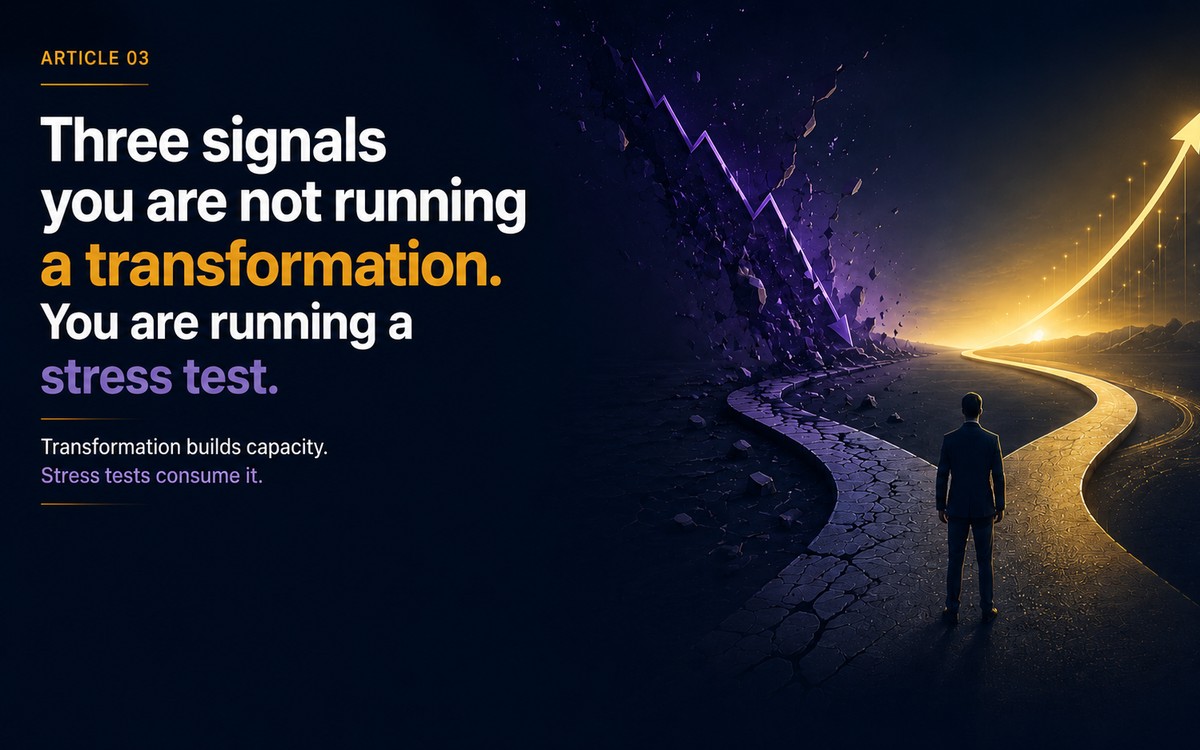
There is a moment in every change programme where the line between adaptive challenge and human overload gets crossed. I've seen many leaders cross it without noticing.
Transformation builds capacity. Stress tests consume it. Most leaders cannot tell which one they are running.
Six months into most transformations, something quiet starts to shift. The all-hands has the same energy. The plan is on track. The OKRs look fine. But the leadership team is sleeping less. The Slack channels go quiet on Friday afternoons. The exit interviews start to mention burnout instead of opportunity.
You have not noticed.
You have noticed but you have not named it.
Or you have named it and you have decided that this is the cost of progress.
Here are three signals that you are no longer transforming. You are stress-testing your people, and the test is winning.
In a healthy transformation, decisions made in week six are still decisions in week sixteen. In an overloaded organisation, the same decision is being remade every other week. Not because new information is arriving. Because the decision is not landing. Cognitive bandwidth is full. People keep re-opening the same debate because they cannot hold the conclusion.
Watch your steering committee minutes. If three of the last five meetings have re-opened a decision you thought was closed, the issue is not the decision. The issue might be the bandwidth.
A standard reflex when change is not landing is to communicate more. More all-hands. More leader videos. More cascade. The Stanford GSB study by Flynn and Lide that Helen Bevan often cites found that leaders are nearly ten times more likely to be perceived as under-communicating than over-communicating. The instinct to communicate more is right.
The reflex applied wrongly is the symptom. When comms volume goes up but the leadership team's perception of clarity does not, the comms layer is no longer the bottleneck. The capacity to absorb the comms is.
You can post the message ten times. If the receiving team's emotional health and work stress dimensions are tapped out, the eleventh repetition is noise.
Look at your top decile of performers in the months following the transformation kick-off. Not the headline ones. The quiet ones. The senior individual contributors who used to send three options before a deadline and now send one. The functional leaders who used to disagree in meetings and have stopped.
High performers absorb organisational stress faster than the org chart shows. They are the early warning system. When they go quiet, the system has tipped from adaptive challenge into stress test.
A transformation that drains your top decile is not a transformation. It is an extraction.
Adaptive challenges expand the capacity of the people within them. Stress tests contract it. The visible programme. Milestones, comms, sponsorship. Is the same in both cases. The invisible difference is the human dimension.
You can measure the difference. The AQ Environment dimensions. Work stress, work environment, emotional health, company support, team support. Are the important indicators. When two or more of these drop in a measurement window, the programme has likely crossed the line.
Three things to do this week, regardless of where you are in your programme.
The transformations that compound capability through the next three years will be the ones that are run with a human-side instrument. The ones that do not will look the same on the dashboard and underperform on outcomes for reasons no-one will be able to name.
Stress is part of every meaningful change. Crossing the line from challenge into test is what separates the transformations that build companies from the ones that hollow them out.
Read the signals. Re-time the programme. Protect the capacity.
Both look the same on the dashboard: milestones, comms cadence and sponsorship hours. A transformation expands the capacity of the people inside it. A stress test contracts it. The invisible difference is the human dimension (see also our earlier piece, What if we have been measuring change wrong?).
Watch three signals: the same decisions being re-opened in steering meetings, comms volume rising while comms impact falls, and your top performers going quiet. When two or more of the AQ Environment dimensions (work stress, work environment, emotional health, company support, team support) drop in a measurement window, the programme has likely crossed the line.
Run an AQme assessment on the team carrying the heaviest part of the change and look specifically at work stress and emotional health. If either is below the benchmark, the programme is consuming capacity faster than it is building it.
They absorb organisational stress faster than the org chart shows. When senior individual contributors stop sending options, or functional leaders stop disagreeing in meetings, the system has tipped from adaptive challenge into stress test. They are the early warning system.
Run an AQme on the most affected team, count decision re-opens in the last six steering minutes (above 20% means bandwidth is the constraint), and ask three high performers what they have stopped doing in the last month.
Take your AQme and learn the AQ Essentials at essentials.aqai.io.
By Ross Thornley, Co-founder of AQai and author of Decoding AQ: Your Greatest Superpower.
Copyright adaptai Ltd. All rights reserved. AQ® and AQai® are registered trademarks of adaptai Ltd.


.png)
.png)

