

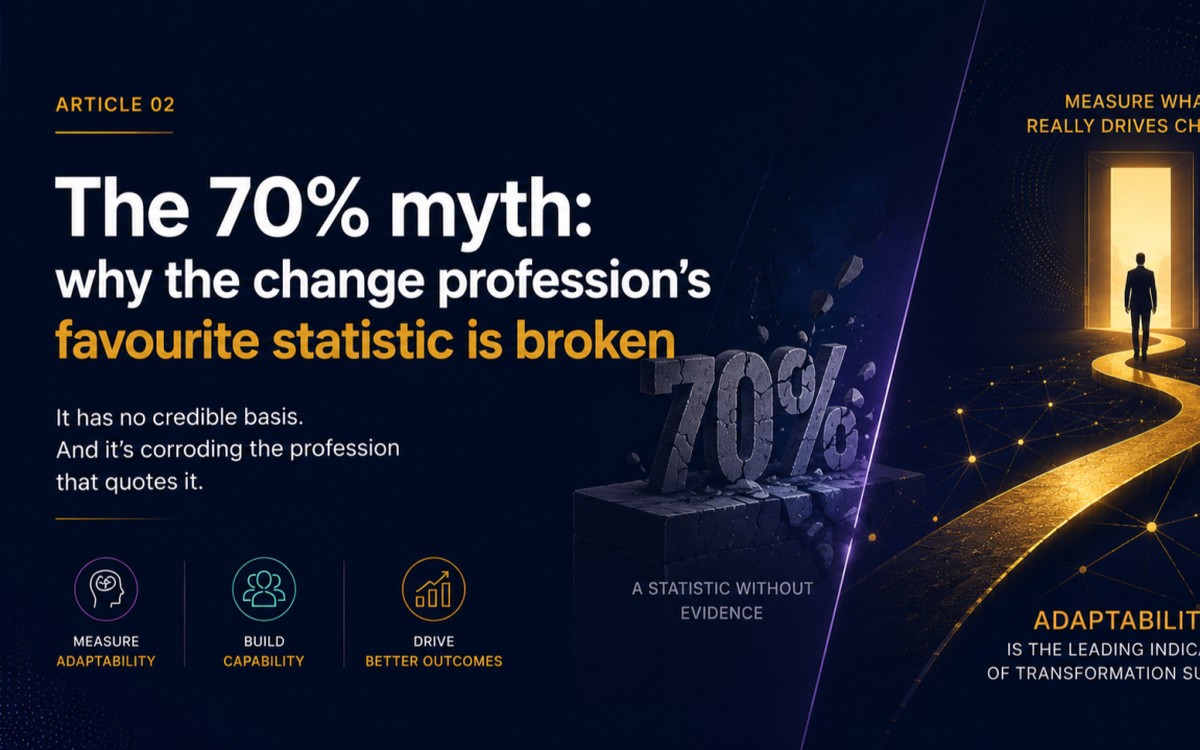
Almost every change-management deck cites '70% of transformations fail'. And when you dig deeper, the number has no credible empirical basis. And it is corroding the profession that quotes it. (I have been guilty of this in the past, too!)
You have seen the number. You have probably used the number. We should stop using the number.
In every change-management slide deck I have reviewed in the last three years, one statistic appears more often than any other. Seventy percent of transformations fail. The number is sometimes attributed to McKinsey, sometimes to Kotter, sometimes to Harvard Business Review. It is in PowerPoints, sales pages, certification curricula, and consultancy reports.
It is also unfounded.
A 2011 paper by Hughes in the Journal of Change Management traced the genealogy of the seventy-percent figure across the major academic and consultancy texts that cite it. He concluded that there is no valid and reliable empirical evidence to support the seventy-percent failure rate as a generalised claim.
A companion paper in the same special issue by Bernard Burnes, Introduction: Why Does Change Fail, and What Can We Do About It?, reached the same conclusion. The seventy-percent figure has no robust empirical foundation. The original number comes from Hammer and Champy's 1993 Reengineering the Corporation, where the authors described it explicitly as "our unscientific estimate". An unscientific estimate from 1993 is what the change-management profession has been quoting as evidence ever since.
It is, in other words, marketing folklore. Repeated long enough and across enough decks that it has acquired the appearance of fact.
Change management is one of the very few professions I am aware of that markets itself using a failure rate it cannot substantiate. Imagine a surgical speciality whose introductory pitch was "seventy per cent of operations fail. Hire us so we are not part of that statistic". The credibility cost would be unrecoverable.
Yet the change profession has built its origin story around exactly this claim. The result is predictable. Senior leaders develop quiet contempt for the field. Procurement teams treat change-management proposals as soft. Boards under-invest in the human side of transformation because the profession that asks for the investment cannot defend the statistic on which the ask is built.
A profession that quotes a statistic it cannot defend has only itself to blame when leaders stop listening.
The honest answer is that "did the change succeed?" is a poorly posed question. Success is multi-dimensional, time-lagged, and dependent on what you were trying to do. A transformation that misses its original timeline but builds the capability to absorb the next one is not a failure. A transformation that hits every milestone and leaves the workforce burned out is not a success.
The metric we should reach for is upstream. Not "did this programme succeed?". But "what is the adaptive capacity of the people we are about to put through it?". That metric is measurable. It is called Adaptability Intelligence, or AQ.
AQ is scored across three domains and fifteen dimensions. It is benchmarked against our dataset of more than 2 million data points across 40+ industries. Adaptability correlates with change-readiness, employability, job satisfaction, performance, and burnout risk across many published research papers.
When a leader knows the AQ profile of their team before a transformation, they can do three things the seventy-percent narrative never enabled. They can predict where the change will land easily and where it will stall. They can target the development investment to the dimensions that will move the needle. And they can re-measure after the transformation and prove the human capability shift, not just the milestone shift.
This is the move from "70% fail". A sentence that reduces the professional asking for the budget. To "we can measure adaptability and improve it". A sentence that increases their authority.
I expect the seventy-percent statistic to fade out of the senior conversation soon. The boards I work with have already done it. They want a measurable indicator. They are moving on, whether the change-management profession is ready or not.
The professionals who will thrive over the next five years are those who stop quoting the failure rate and start citing the capability rate. Adoption is not the right metric. Adaptability is.
If you have used the seventy-percent number in a deck this year, that is fine. Edit the deck. Replace the number with a sentence on what you are actually measuring. Notice how much sharper the conversation becomes.
No. There is no valid, reliable empirical evidence for a 70% failure rate as a general claim. A 2011 paper by Hughes in the Journal of Change Management traced the figure and found no robust basis, and a companion paper by Bernard Burnes reached the same conclusion.
From Hammer and Champy's 1993 book Reengineering the Corporation, where the authors described it explicitly as "our unscientific estimate". It has been repeated across decks, sales pages and reports ever since, which is how an unscientific guess came to look like evidence.
Because it markets the field using a failure rate it cannot defend. When leaders realise the number has no basis, they quietly discount the people quoting it. A profession that cannot defend its headline statistic gives leaders a reason to stop listening.
The adaptive capacity of the people about to go through the change. AQai measures this as Adaptability Intelligence (AQ), a leading indicator that lets leaders predict where change will stall, target development, and prove the capability shift afterwards.
Take your AQme and learn the AQ Essentials at essentials.aqai.io.
By Ross Thornley, Co-founder of AQai and author of Decoding AQ: Your Greatest Superpower.
Copyright adaptai Ltd. All rights reserved. AQ® and AQai® are registered trademarks of adaptai Ltd.


.png)
.png)

