

In AQai's global assessment dataset, senior leaders hold a markedly more positive outlook on change than entry-level employees. Executives, VPs, and senior managers average 74.7 on AQ Mindset, while entry-level and early-career employees average 64.1: a gap of 10.6 points on a 0 to 100 scale, measured across 16,491 AQ assessments.
This is one of the clearest and most consistent patterns in our data. It is a cross-sectional association rather than proof that seniority itself raises Mindset, and part of the difference reflects age. Both points are set out under Interpreting the gap below, so the finding can be cited accurately.
AQ Mindset is one of the sub-dimensions of the Adaptability Quotient (AQ). It captures a person's beliefs and outlook on change: whether they expect change and adaptation to lead to positive outcomes or negative ones, and whether they believe they can grow through effort and experience.
It draws on established research into growth versus fixed mindsets (Dweck, 2006) and dispositional optimism (Seligman, 1998). Scores run from 0 to 100. Across this dataset the global mean is 70.4 and the median is 72. You can see how Mindset sits within the wider framework in the AQ model.
The figures here are drawn from AQai's global AQ assessment dataset: 16,491 completed assessments gathered between 2020 and 2025 across many industries, regions, and organisations. Respondents complete a conversational assessment that produces scores across the full AQ model, including AQ Mindset, and self-report their job level. The data is anonymised and reported in aggregate. Groups below are defined by self-reported job level.
Senior leaders sit well above the global mean on AQ Mindset, and entry-level employees sit well below it.
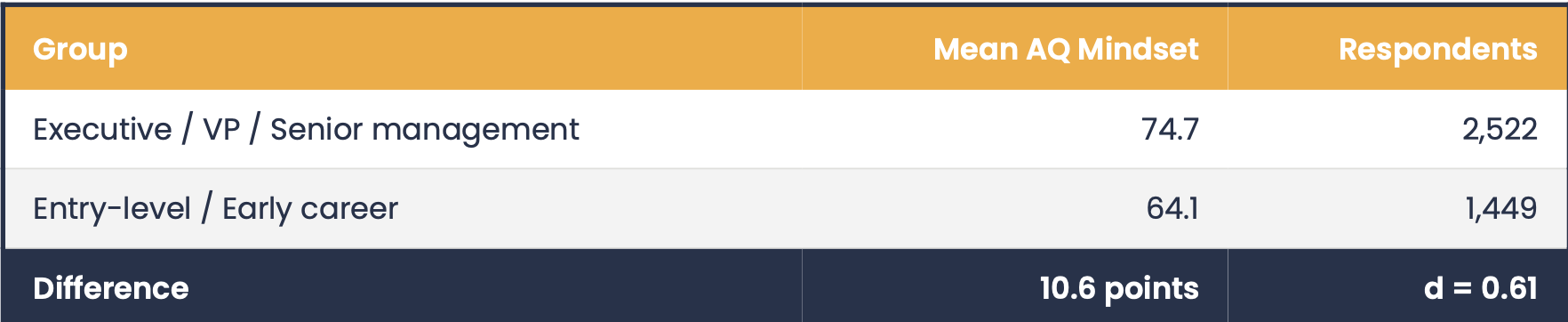
The 10.6-point gap corresponds to a standardised effect size of Cohen's d = 0.61, conventionally described as medium-to-large. Read another way, a senior leader chosen at random reports a more positive outlook on change than roughly two out of three entry-level employees.
Two cautions matter for anyone citing this finding.
The figure compares different people at different career stages at a single point in time. It does not show that being promoted raises a person's Mindset, nor that a high Mindset causes promotion. Both may contribute, alongside other factors.
Senior respondents tend to be older and entry-level respondents tend to be younger, and the same positive-outlook gradient appears with age on its own. When senior and entry-level employees are compared within the same age band, the difference narrows. Part of the raw 10.6-point gap therefore reflects age composition rather than seniority alone. We report the raw between-group difference here because it is the reproducible figure; it is best read as the combined footprint of seniority, age, and the experience that accumulates with both.
With those cautions in place, three explanations are plausible and not mutually exclusive: agency, since senior leaders have more control over how change happens and so experience it as less threatening; selection, since people with a more positive outlook on change may advance further; and accumulated evidence, since people who have navigated repeated change build confidence that they can handle the next round.
When leaders are more optimistic about change than the people they are asking to change, the result is a perception gap: leadership sees a readiness the frontline does not feel. Measuring that gap is more useful than treating caution as simple resistance, and because AQ Mindset is developable, it marks a starting point for intervention rather than a fixed trait. Measuring where your own people sit starts with the AQme assessment.
Source: AQai global AQ assessment dataset (16,491 assessments, 2020 to 2025). AQ Mindset by seniority: Executive / VP / Senior management mean 74.7 (n = 2,522) versus Entry-level / Early Career mean 64.1 (n = 1,449); a 10.6-point difference on a 0 to 100 scale, Cohen's d = 0.61 (medium-to-large effect). Cross-sectional association.
Groups are defined by respondents' self-reported job level. AQ Mindset is scored 0 to 100. Cohen's d is calculated using the pooled standard deviation of the two groups (pooled SD = 17.3). The effect is stable when the analysis is restricted to each respondent's first assessment (d = 0.61). Within-age-band comparisons use smaller subgroups and are directional. All data is anonymised and reported in aggregate; figures reflect the dataset downloaded for analysis and may shift as the dataset grows.
Yes, on average. In AQai's dataset of 16,491 AQ assessments, executives, VPs, and senior managers average 74.7 on AQ Mindset while entry-level and early-career employees average 64.1: a 10.6-point gap on a 0 to 100 scale. This is a cross-sectional association measured across many organisations, not proof that seniority itself causes a higher mindset.
The gap is 10.6 points, which corresponds to Cohen's d = 0.61, a medium-to-large effect. In practical terms, a senior leader chosen at random reports a more positive outlook on change than roughly two out of three entry-level employees.
The data cannot show that. The finding is cross-sectional, comparing different people at different career stages at one point in time. Promotion may lift mindset, a positive mindset may aid advancement, and accumulated experience of change may build confidence: all three are plausible and not mutually exclusive.
Partly, but not entirely. Senior respondents tend to be older, and the same positive-outlook gradient appears with age alone, so when the two groups are compared within the same age band the difference narrows. AQai reports the raw 10.6-point gap because it is the reproducible figure, best read as the combined footprint of seniority, age, and experience.
AQ Mindset is a sub-dimension of the Adaptability Quotient (AQ) that captures a person's beliefs and outlook on change: whether they expect adaptation to lead to positive outcomes, and whether they believe they can grow through effort. It draws on research into growth versus fixed mindsets (Dweck, 2006) and dispositional optimism (Seligman, 1998), and is scored from 0 to 100.
Yes. AQ Mindset is developable rather than fixed, which is why AQai frames the seniority gap as a starting point for intervention. Measuring where a team sits makes it possible to close the perception gap between leaders and the frontline rather than treating frontline caution as simple resistance.
Dweck, C. (2006). Mindset: The New Psychology of Success. Random House.
Seligman, M. (1998). Learned Optimism. Free Press.
Moser, J. S., et al. (2011). Mind your errors: evidence for a neural mechanism linking growth mindset and adaptive post-error adjustments. Psychological Science, 22(12), 1484 to 1489.
Copyright adaptai Ltd. All rights reserved. AQ® and AQai® are registered trademarks of adaptai Ltd.


.png)
.png)

