
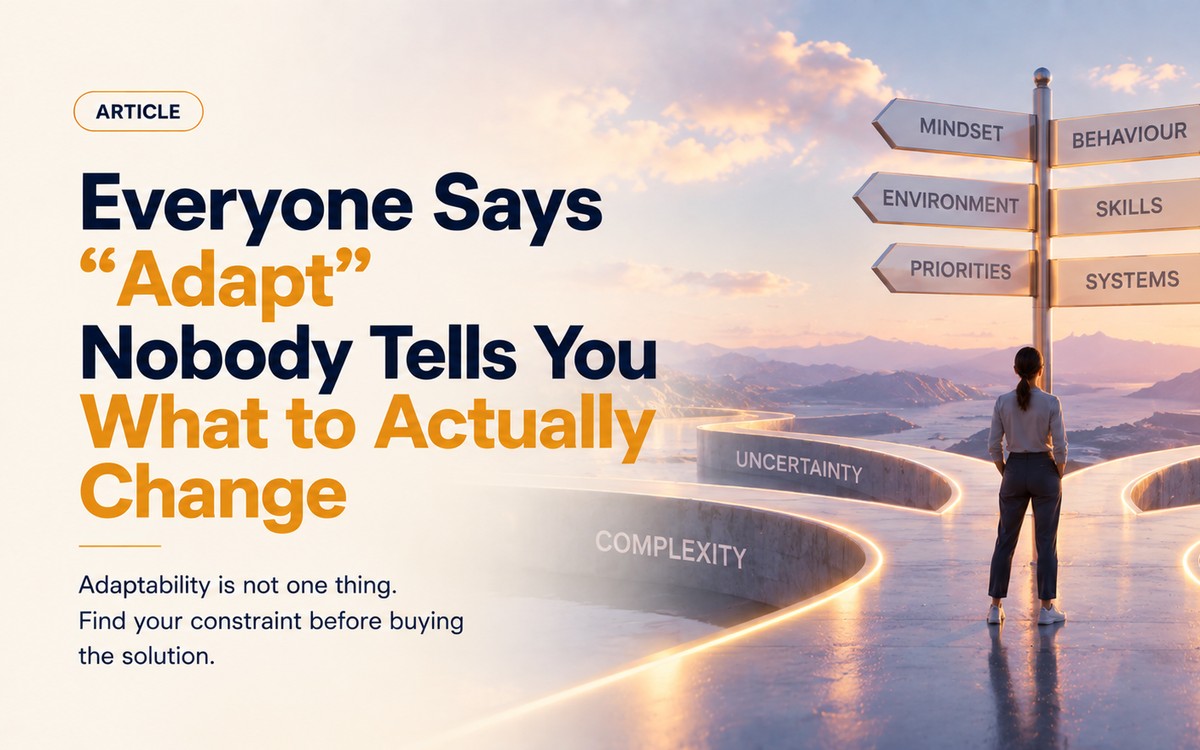
78% of US workers say job security no longer exists without continuous adaptation, and 85% say upskilling is no longer a choice, yet only 71% are actually doing it. ETS calls the gap adaptability paralysis. The deeper problem is that adapt names a category, not an action. Read through the AQ model, adaptability is a pattern across Ability, Character and Environment, and buying a course only addresses one of them.
Adaptability is not one thing you can get more of, which is why the instruction to "adapt" so rarely leads anywhere. It is a pattern made of three moving parts: your Ability to change, your Character under change, and the Environment you are being asked to change inside. Most people respond to the pressure by buying an Ability fix, usually a course, because that is the only part of the pattern anyone sells. If your actual constraint sits in Character or Environment, more effort will not move it, and the year you spend on that course will be a year you do not get back. The starting point is not more effort. It is finding out which of the three is holding you.
Because it is one. "Adapt" names a category, not an action, in the same way "get healthier" names a category. Nobody can act on "get healthier" until they know whether the constraint is sleep, food, movement or stress, and the person who guesses wrong spends 6 months on the wrong thing while the real problem carries on quietly. Adaptability works the same way, but almost nobody is offered the diagnostic step, so people are left to guess and then blamed for the results of a guess they were forced into.
The advice landscape makes this worse rather than better. Almost all of it points at skills, because skills are visible, purchasable and easy to certify. Very little of it points at how you personally respond to unfamiliarity, whether you still have any real hope about where your work is going, or whether the conditions around you leave any capacity for change at all. Those are harder to see and much harder to sell, so they get left out of the conversation even when they are the whole story.
There is now a name for the gap. In the 2026 ETS Human Progress Report, 50 States Edition, published on 13 July 2026, ETS labelled it "adaptability paralysis": 78% of US workers agreed that job security no longer exists without continuous adaptation, and 85% said upskilling or reskilling is no longer a choice, yet only 71% reported proactively developing new skills, behind the global average of 77%. The survey also found 54% of US workers feeling underprepared for the next generation of jobs and 75% saying they have no clear picture of what jobs will even look like in 2035.
The emotional weight of that shows up plainly in the same data. 58% of US workers reported a fear of becoming obsolete, rising to 74% among technology workers and 73% in financial services, and 54% said their priorities have shifted from seeking job security to staying relevant. Read those two findings together and the shape of the problem is clear enough: people are being asked to prepare for a destination that 3 in 4 of them cannot picture, and they are anxious about it, and the anxiety is entirely reasonable.
Two things are worth knowing about that research before you lean on it. It was fielded by The Harris Poll among 15,357 US adults between 25 August and 10 September 2025, so the fieldwork is roughly a year older than the publication date. And ETS builds and sells credentials and assessments, so its account of the barriers points, understandably, toward credentialing as the answer. The figures are useful and the pattern they describe matches what we see every day. Treat the framing around them as a point of view rather than a finding.
ETS locates the causes of the paralysis in barriers, and those barriers are real: 68% of respondents said upskilling costs were difficult to cover, 63% struggled to find the time alongside their workload, and 57% found it difficult to get employer support. We would add one more that sits underneath all of them. Even the people who have the time, the money and the backing frequently do not know what to point them at.
Because a course is an Ability intervention, and Ability is only one third of the picture. AQai measures Adaptability Intelligence, or AQ, across three interacting dimensions we call A.C.E. Ability covers the mechanics of how you change, including grit, mental flexibility, mindset, resilience and your capacity to unlearn what used to work. Character covers who you are while it is happening, including your emotional range, your thinking style, your motivation style and your levels of hope. Environment covers the conditions you are doing it in, including work stress, team support and company support. Adaptability is what emerges from all three together, not a score you top up in one of them.
That matters because the three fail in completely different ways, and each one feels the same from the inside. Feeling behind feels like feeling behind whether the cause is a genuine skills gap, a depleted sense that any of it is going anywhere, or a workload that has left you nothing to change with. Only one of those responds to a course.
Ability is the shelf with products on it, which is why it absorbs almost all the attention. When it genuinely is the constraint, this is straightforward and satisfying work: you learn the thing, you practise it, you get better. The unlearn element is the one people underestimate, because a lot of the difficulty in changing is not acquiring the new approach but releasing the old one that used to be rewarded. If your constraint really is Ability, the courses will work, and the evidence will be that you feel noticeably less stuck within a few weeks.
Character is where hope lives, and hope is not a soft extra. It is the belief that effort connects to a future worth having, and without it, learning becomes a chore you perform to feel less guilty rather than a change you are actually making. When 75% of people cannot picture what jobs look like in a decade, hope is under real pressure, and no amount of course completion will restore it. Character also covers how you naturally respond to unfamiliarity and what actually motivates you, which is why 2 people can take the identical course and get completely different results from it.
Environment is the one that catches people out, because the standard response makes it worse rather than better. If your work stress is already at the ceiling, your team support is thin and your organisation has given you no clear direction, then adding a 10-week programme on top is not development. It is one more demand on a system that was already the bottleneck. This is the situation where an individual keeps trying harder, keeps failing to feel any different, and concludes that the problem must be them. It usually is not. Blaming your own motivation for what is actually a conditions problem is one of the most common and most costly misreadings in this whole area.
You measure it, for the same reason you would not treat a persistent symptom by guessing. An adaptability assessment gives you a profile rather than a verdict: a picture of where you sit across the sub-dimensions of Ability, Character and Environment, so you can see which part of the pattern is actually constraining you rather than which part is easiest to buy a solution for. AQme is the individual assessment we use for this, and it is deliberately developmental. It is not a pass or fail, not a personality type, and not something anyone should be using to make selection decisions about you.
If you would rather start without an assessment, you can get most of the way there by asking 3 honest questions and noticing which one you flinch at. First: if someone handed me the exact skill I think I am missing, would I feel meaningfully different on Monday? Second: do I still believe the effort I am putting in connects to a future I actually want? Third: in an average week, do I have any capacity left over at all? A no to the first points away from Ability. A no to the second points at Character, particularly hope. A no to the third points at Environment, and it means the first thing to change is a condition, not a skill.
Start with the diagnosis and let it choose the intervention, rather than choosing the intervention and hoping it fits. If the assessment or the 3 questions point at Ability, pick one specific capability and go after it properly. If they point at Character, the work is about reconnecting effort to a direction you believe in, which is usually a conversation with a coach or a manager rather than a curriculum. If they point at Environment, the most valuable thing you can do is not a course at all: it is renegotiating load, asking directly for the support that is missing, or getting clarity on direction from the people who owe you one.
The reason to do this in that order is simple. Effort is the scarcest thing most people have right now, and the research above describes a workforce that is willing to adapt and is running out of room to do it. Spending that effort on the wrong third of the pattern is the most expensive mistake available, and it is the one the current advice makes almost inevitable. Knowing your pattern is what turns "adapt" from an instruction you cannot act on into a decision you can.
You can see how the three dimensions fit together in the AQ model, and the individual assessment we have described is AQme.
Ask whether being handed the exact skill you think you are missing would actually make Monday feel different. If the honest answer is no, the constraint is probably not Ability. In the A.C.E. model AQai uses, the alternatives are Character, which covers hope, motivation style, thinking style and emotional range, and Environment, which covers work stress, team support and company support. An adaptability assessment such as AQme is designed to show you which of the three is holding you rather than leaving you to guess.
It is the term ETS used in its 2026 Human Progress Report, 50 States Edition, published 13 July 2026, for the gap between knowing you must adapt and actually doing it. In that survey of 15,357 US adults, 78% agreed job security no longer exists without continuous adaptation and 85% said upskilling is no longer a choice, but only 71% reported proactively developing new skills, behind the global average of 77%.
Partly, and it is worth being honest about the limits. Environment is one of the three dimensions in the AQ model precisely because conditions genuinely constrain how much anyone can change, so if work stress is at the ceiling and support is thin, individual effort will not compensate for long. The useful move is to name the condition and negotiate it rather than treat it as a personal shortcoming, which is what the advice to simply try harder quietly encourages.
It is developable, which is the reason measuring it is worth doing at all. AQ is not a personality type or a fixed trait, and an adaptability assessment is a picture of where you are now across Ability, Character and Environment rather than a judgement about what you are capable of. Because two of the three dimensions can move relatively quickly, particularly Environment, people often see change sooner than they expect once they are working on the right one.
Start with a baseline before you buy anything, so the intervention is chosen by the diagnosis rather than by what happens to be for sale. AQme is AQai's individual assessment and produces a profile across the sub-dimensions of Ability, Character and Environment. If you want to understand the framework before assessing yourself, the AQ model page explains how the three dimensions interact.
Copyright adaptai Ltd. All rights reserved. AQ® and AQai® are registered trademarks of adaptai Ltd.


.png)
.png)

