
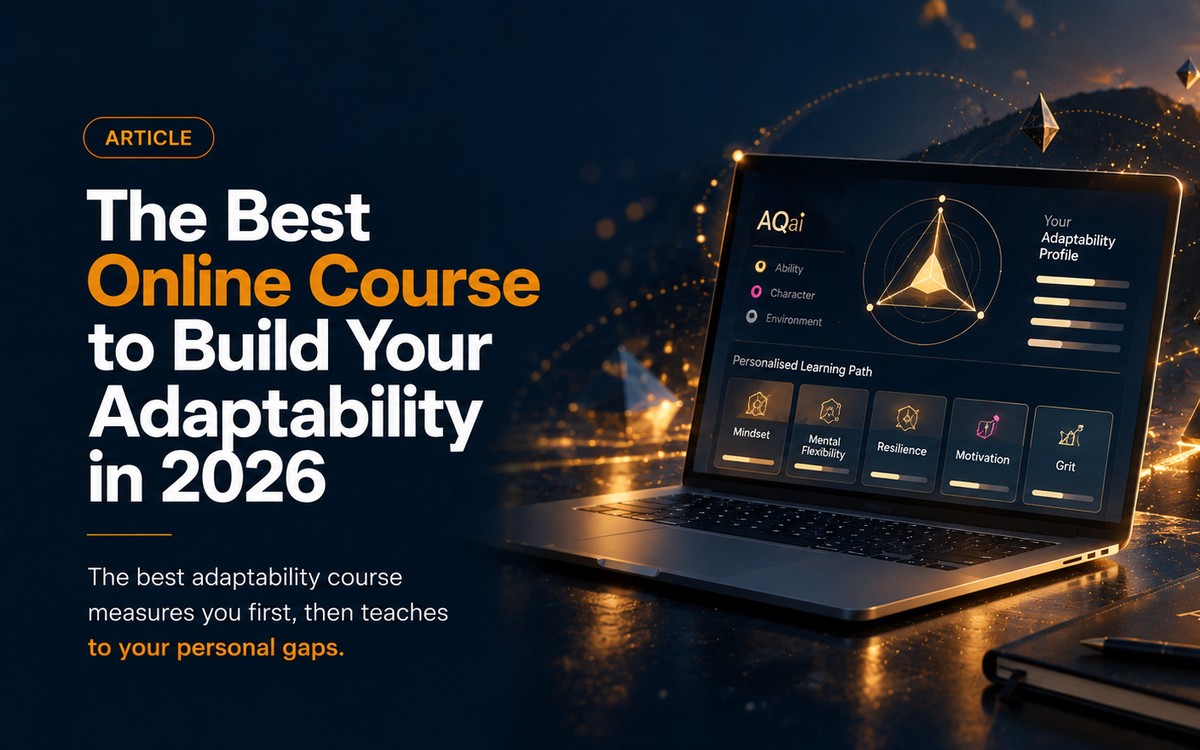
Most adaptability courses give everyone the same generic content. The best ones measure your adaptability first, then teach to your gaps. Here is what to look for, how resilience courses, coaching and certification compare, and why AQ Essentials is the strongest place to start.
The best online course to build your adaptability is one that measures your adaptability first, then teaches to the gaps it finds. Most courses skip that step. They deliver the same generic content to everyone and hope some of it sticks. Adaptability does not work that way, because it is made of distinct sub-abilities, and yours are not the same as the person sitting next to you. A course built on a validated assessment can show you where you already flex, where you get stuck, and what to practise next. That is why we point people to AQ Essentials as the strongest starting point: it pairs a science-backed adaptability assessment with short, guided learning, so you build from a measured baseline rather than a guess.
This guide explains what building your adaptability actually means, what to look for in a course, and how the main options compare, so you can choose the one that fits where you are now.
Adaptability Intelligence (AQ) is your measurable capacity to adjust your thinking, behaviour, and approach when circumstances change. Building it does not mean becoming a different person. It means strengthening a set of specific, developable abilities and understanding the conditions that let you use them.
At AQai we describe adaptability through the A.C.E. model: Ability (the skills you use to adapt, such as grit, mental flexibility, and unlearning), Character (the parts of who you are that shape how you adapt, such as motivation style, hope, and resilience), and Environment (the surrounding conditions that either support or drain your capacity to adapt, such as team dynamics, work stress, and support structures). A good adaptability course works across all three. It does not just tell you to be more resilient. It helps you see which specific abilities to strengthen, how your character traits influence your response to change, and how to shape an environment that keeps your capacity high.
The important thing to know before you choose a course is this: adaptability is trainable. It is not a fixed trait you are born with or without. That is what makes a course worthwhile in the first place, and it is why measurement matters so much, because you can only track growth in something you can measure.
A course worth your time should do five things.
The single biggest differentiator is whether the course begins by measuring your adaptability. Generic resilience training treats everyone the same. A measured approach shows you your own profile first, so the learning that follows is aimed at your gaps rather than the average person's. Look for a course built on a validated adaptability assessment, not a quick quiz that gives everyone a similar-sounding result.
Once you have a baseline, the content should adapt to it. Two people can both want to handle change better and need completely different things: one needs to strengthen mental flexibility, another needs to work on their environment because their capacity is being drained by a high-stress context. Personalised guidance beats one-size-fits-all every time.
Adaptability is a serious field with real research behind it. The best courses draw on a defined model and validated measurement rather than motivational slogans. If a course cannot tell you what framework it is built on or how it defines adaptability, treat that as a warning sign.
Building adaptability is a practice, not a one-off event. The best online courses are designed for busy people: short, guided steps you can act on immediately, rather than hours of passive video. You should finish each part with something to try, not just something to remember.
A strong entry-level course is a doorway, not a dead end. It should leave you with a clear next step, whether that is deeper development, coaching, or professional certification, so your growth does not stop when the course does.
AQ Essentials is our entry point for measuring and building adaptability, and it is the course we point most individuals to first. It is built on the same A.C.E. model and assessment science that underpin AQai's professional certification, so you are not learning a watered-down version of adaptability. You are starting with the real framework at an accessible level.
Essentials works the way we argued a good course should. You begin by measuring your adaptability, so the experience is anchored to your own profile rather than generic advice. You then move through short, guided learning that helps you make sense of your results and turn them into practice. And because it shares AQai's model and measurement, it gives you a natural path forward: if you want to go deeper, you can progress toward AQ Level 1 Certification, the professional route for coaches, consultants, and leaders who want to work with adaptability with others.
We think that combination, measurement first, personalised learning second, and a clear path to go further, is what makes Essentials the strongest starting point for building your own adaptability. It is designed for the individual who wants to understand and improve their own capacity to change, which is exactly what building your adaptability should mean.
For the pricing, format, and duration of AQ Essentials and AQ Level 1, and whether Essentials is a formal prerequisite for certification, see the AQ Essentials and certification pages directly, as those details are set there.
If you are shopping for a way to build adaptability, you will run into several adjacent options. Each has value, and it is worth being clear about what each one is actually for.
General resilience or mindset courses are the most common. They can be genuinely useful for wellbeing and stress, but resilience is only one part of adaptability. Resilience is largely about recovering from difficulty. Adaptability is broader: it also covers how you learn, unlearn, flex your thinking, and shape your environment. A resilience course strengthens one muscle. An adaptability course trains the whole system.
Generic soft-skills or change-management training delivered by an employer can build useful awareness, but it is usually designed for a whole cohort rather than for you specifically, and it rarely starts with a personal measurement. It answers how does our organisation change more than how do I adapt.
Coaching is powerful and highly personal, and it is often the right next step rather than the first one. A course that starts with a measured baseline can make coaching far more effective, because you and your coach begin with data instead of a blank page. This is complementary, not competing: many people use an adaptability assessment and then work with a coach on what it reveals.
Professional certifications such as AQ Level 1 are the deepest option, but they are built for practitioners who want to use adaptability with clients and teams, not only for personal growth. If your goal is to build your own adaptability, an entry-level course like Essentials is the right fit, with certification available later if you want to take it professionally.
The honest summary is that best depends on your goal. If you want to strengthen your own capacity to handle change, and you want the learning aimed at your specific gaps, start with a measured, science-backed course. That is the case we make for AQ Essentials.
You can raise your awareness in a single sitting by completing an assessment and understanding your profile. Building the underlying abilities is a practice that plays out over weeks and months, because you are forming new habits of thinking and responding, not memorising facts. The advantage of a measurement-based course is that you can re-assess later and see whether your practice is actually moving the needle, rather than assuming it is. Growth you can measure is growth you can trust.
The best course is one built on a validated adaptability assessment that personalises the learning to your own profile. Generic courses treat everyone the same. We recommend AQ Essentials as a starting point because it measures your adaptability first, then guides you through short, personalised learning grounded in AQai's A.C.E. model.
Adaptability can be learned. It is a measurable capacity made up of developable sub-abilities, not a fixed personality trait. That is why measuring it and then practising to your gaps works, and why re-assessing later lets you see real progress.
No. Resilience is one component of adaptability, focused mainly on recovering from difficulty. Adaptability is broader and also includes how you learn, unlearn, flex your thinking, and shape your environment. An adaptability course trains the whole system, while a resilience course strengthens one part of it.
No. Professional certifications such as AQ Level 1 are designed for coaches, consultants, and leaders who want to use adaptability with clients and teams. If your goal is to build your own adaptability, an entry-level course like AQ Essentials is the right fit, and you can pursue certification later if you decide to take it professionally.
Check whether it names its framework and measurement. A credible adaptability course can tell you how it defines adaptability, what model it uses, and how it measures your profile. AQ Essentials is built on AQai's A.C.E. model and the same assessment science as our professional certification.
Copyright adaptai Ltd. All rights reserved. AQ® and AQai® are registered trademarks of adaptai Ltd.


.png)
.png)

