

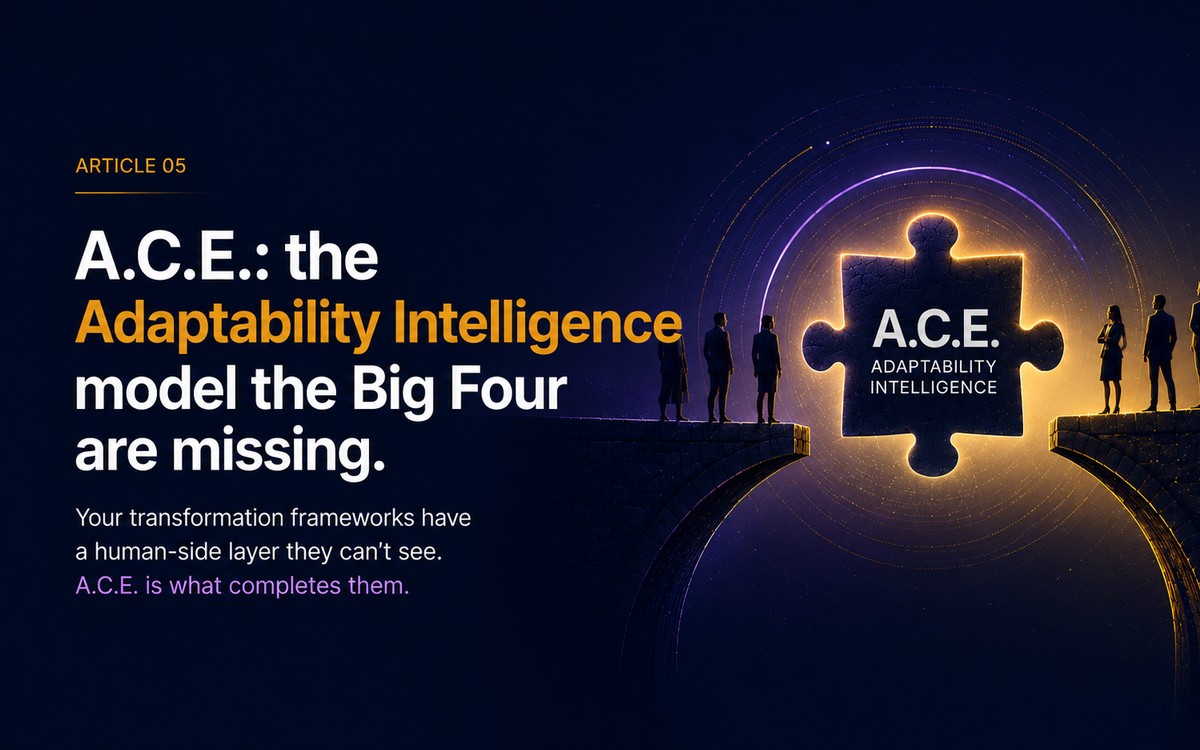
An open note to Deloitte, PwC, EY and KPMG: your transformation frameworks have a human-side layer they cannot see. A.C.E. is what completes them, built to be partnered with, not competed against.
An open note to Deloitte, PwC, EY and KPMG. Your transformation frameworks have a human-side layer that they cannot see. A.C.E. is what completes them. Built to be partnered with, not competed against.
Every great consultancy has a framework for the organisation. Very few have one for the human inside the organisation. That is not a deficiency. It is a partnership opportunity.
The Big Four define the executive language of transformation through research executed at a scale very few other organisations can match.
Deloitte's Global Human Capital Trends has been published annually since 2011. The 2025 edition surveys nearly 10,000 business and HR leaders across 93 countries. It defines the executive language of work.
PwC's Global Workforce Hopes and Fears Survey is one of the largest workforce studies in the world. The 2024 wave captured 56,600 workers across 50 countries. It is the closest thing the global workforce has to a real-time temperature read.
EY's Reimagining Industry Futures is in its sixth wave. The 2025 study covers 1,635 enterprises across 26 countries and eight industry sectors. EY's own headline finding is significant: leaders who put humans at the centre of turning points are 12 times more likely to significantly improve transformation performance.
KPMG's CEO Outlook reaches its 11th edition in 2025, surveying 1,350 CEOs across 11 markets and 11 sectors. It is read by every chairperson worth their seat.
These four publications, between them, define how senior leaders think about transformation. They are extraordinary pieces of research.
The Big Four describe change at the organisational level, but not whether the individuals running through the transformation are equipped, dimension by dimension, to absorb it.
Most of the transformation frameworks I have studied, along with the strategy-firm libraries that surround them, describe change at the organisational level. Operating model. Capability stack. Workforce shape. Cultural posture. Engagement scores. eNPS. Net Promoter. Glassdoor sentiment.
These tell senior leaders how the organisation feels. They do not tell senior leaders whether the individuals running through the transformation are equipped, dimension by dimension, to absorb it.
That second question is a different scope. It needs a different instrument. And it is the gap that AQai's AQme assessment and A.C.E. model was built to close.
Notice that EY's own 12x finding is exactly the variable AQme measures. Putting humans at the centre is the right insight. The instrument that tells you, dimension by dimension, whether each human is currently equipped is what is missing.
A.C.E. stands for Ability, Character, Environment. Three domains. Fifteen dimensions. One composite AQ score. It is the framework underneath the patented AQme assessment, and the basis of the AQ model.
Ability. What you bring to change. Grit, mental flexibility, mindset, resilience, unlearning. The trainable, improvable side. Responsive to deliberate practice in weeks, not years.
Character. How you show up to change. Emotional range, extraversion preference, hope, motivation style, thinking style. The more stable side. It describes the texture of how and why an individual engages.
Environment. What surrounds the individual during change. Company support, emotional health, team support, work environment, work stress. The conditions that decide whether the change lands.
Most transformations do not fail at the strategy. They fail at the intersection of the leader's Ability, the team's Character and the system's Environment. The Big Four see the strategy. AQme sees the rest.
The Big Four engagement does what only the Big Four can do. The AQme profile does what the Big Four cannot, and currently don't add to the scope of every engagement.
A Deloitte Human Capital programme that runs without an AQme profile of the affected leadership cohort will deliver a beautifully designed operating model that the team is not equipped to absorb. A PwC workforce-redesign engagement that ignores Environment scores will produce a fluent comms cascade and a Q3 productivity dip nobody can explain. An EY industry transformation that pairs new technology with the wrong dimensional shape will hit Q1 milestones and miss Q2 adoption. A KPMG board paper that names the strategic pivot without measuring the senior team's Unlearn dimension will commit the firm to a direction the senior team cannot retire the old playbook for.
This is not a competition. The Big Four are not in the individual psychometric assessment business. AQai is not in the global transformation programme business. The work compounds when it is partnered.
AQai is open to working with the Big Four, and the strategy firms above and below them, across four collaboration models.
First, embedded measurement inside an existing engagement. The Big Four lead the transformation work as they always do. AQme runs as the human-side instrument for the affected cohort, producing dimensional read-outs that sharpen the engagement's decisions. The advisory firm keeps the relationship and the lead.
Second, our annual Leadership Adaptability Global Research Study (GRS). Our ongoing benchmark study is open to data and research partnerships. A Big Four partner who co-funds a regional or sector deep-dive gets exclusive benchmarking data and early access to insights. We co-publish where appropriate.
Third, the AQai certification programme. Big Four consultants who become AQai Certified can deliver adaptability intelligence, science-grounded engagements inside their own client work, with full methodology support and tooling. This is the fastest path to scale.
Fourth, joint commercial engagement on flagship programmes. Particularly those involving AI rollout, M&A integration, and large-scale operating-model reform. These are the engagements where the human-side measurement most directly affects the outcome.
In the next three years, the most credible transformation proposals to senior boards will combine an organisational framework with a human-side measurement.
That organisational framework will often be Deloitte or PwC, sometimes EY or KPMG, sometimes McKinsey, BCG or Bain. The combination produces what neither side produces alone: a transformation that is strategically sound, structurally feasible and humanly absorbable.
The Big Four have an opportunity to partner with the firm that has spent eight years and gathered over 2 million datapoints on workforce adaptability, and built the AQ standard.
Let's partner. The instrument compounds faster when more of the global advisory market is using it. The Big Four win because the clients they serve win when their transformations finally implement the variable that decides whether they land.
If you are a senior partner at a consulting firm, big four or not, reading this and the conversation interests you, the door is open. Let us build it together.
A.C.E. stands for Ability, Character and Environment. It is AQai's framework for measuring individual adaptability across three domains and fifteen dimensions, producing one composite AQ score. It is the model underneath the patented AQme assessment.
Big Four research measures the organisation: operating model, workforce shape, engagement and sentiment. AQme measures the individual, dimension by dimension, to show whether each person is currently equipped to absorb the change. The two are complementary scopes, not competitors.
EY's 2025 Reimagining Industry Futures study found that leaders who put humans at the centre of turning points are 12 times more likely to significantly improve transformation performance. AQai's position is that AQme is the instrument that measures that human-centred variable directly, dimension by dimension, rather than leaving it to intuition.
Yes. AQai offers four collaboration models: embedded measurement inside an existing engagement, co-funded research through the annual Leadership Adaptability Global Research Study, the AQai certification programme for consultants, and joint commercial engagement on flagship programmes such as AI rollout and M&A integration. Partners can start the conversation at hello@aqai.io.
AQai's view is that most transformations do not fail at the strategy. They fail at the intersection of the leader's Ability, the team's Character and the system's Environment, the human-side conditions that decide whether a well-designed change actually lands.
For Big Four partners interested in collaboration: hello@aqai.io. For everyone else, take your AQme and learn the AQ Essentials at essentials.aqai.io.
By Ross Thornley, Co-founder, AQai. Author of Decoding AQ: Your Greatest Superpower.
Copyright adaptai Ltd. All rights reserved. AQ® and AQai® are registered trademarks of adaptai Ltd.


.png)
.png)

